







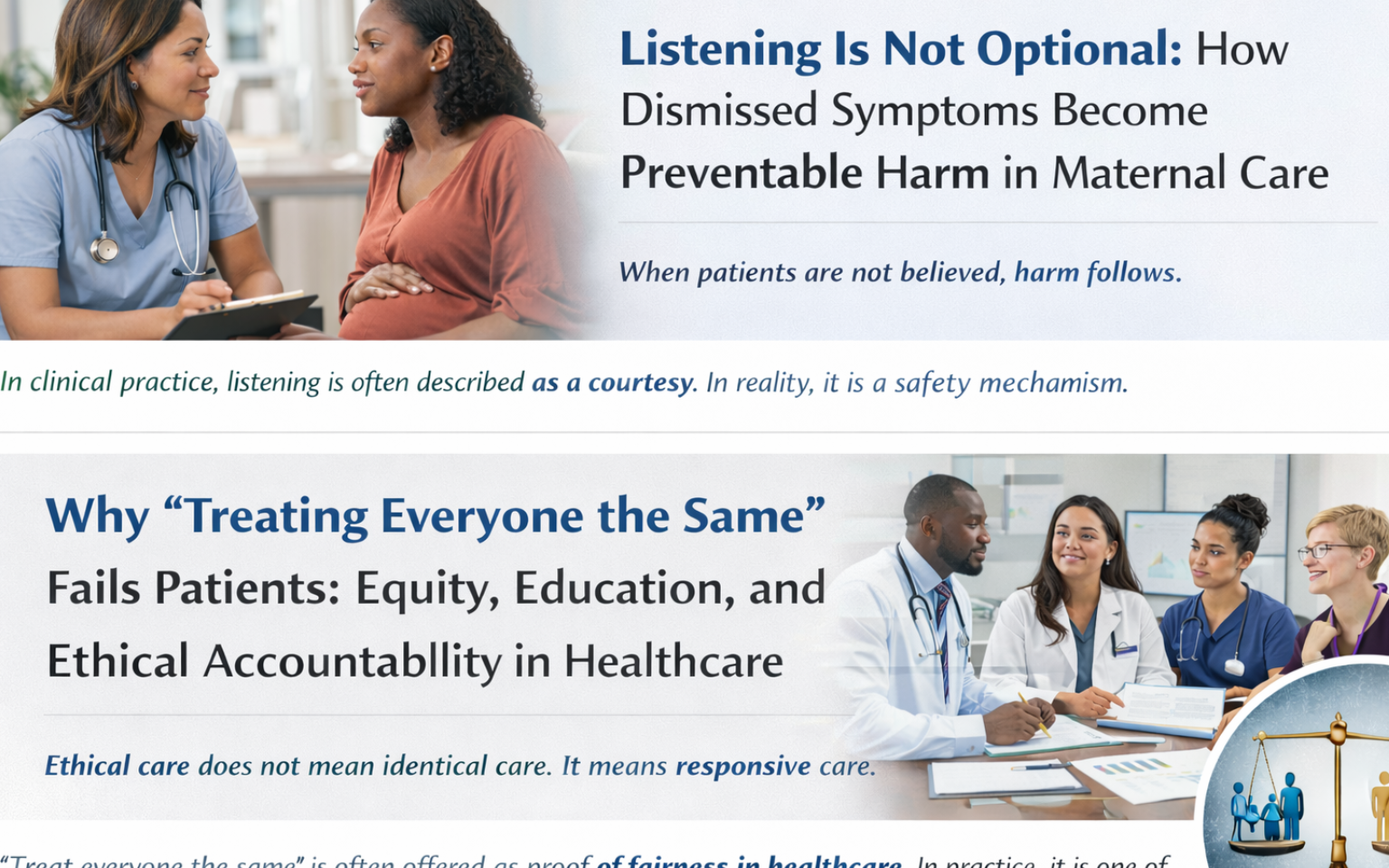
Listening Is Not Optional: How Dismissed Symptoms Become Preventable Harm in Maternal Care
In clinical practice, listening is often described as a courtesy. In reality, it is a safety mechanism.
As a Family Nurse Practitioner, nurse educator, and healthcare practice consultant, I have reviewed countless cases where patients clearly communicated concern—yet their symptoms were minimized, reframed, or delayed in escalation. These are not rare events. They are patterns. And in maternal healthcare, those patterns carry disproportionate consequences for Black and Brown patients.
When patients are not believed, harm follows.
When Symptoms Are Heard—but Not Acted On
The most dangerous communication failures are not always loud or dramatic. They often occur quietly, documented in the chart but deprioritized in action.
The Centers for Disease Control and Prevention (CDC) reports that over 80% of pregnancy-related deaths in the U.S. are preventable, and that delayed recognition of warning signs is a recurring factor. The CDC notes:
“Failure to recognize symptoms or delayed response to clinical deterioration continues to contribute significantly to maternal morbidity and mortality.”
From my professional experience, the issue is rarely a lack of knowledge. It is more often a failure of perception—whose symptoms are taken seriously, whose intuition is trusted, and whose voice is seen as credible.
Credibility Is Not Evenly Distributed
Research consistently shows that Black women are less likely to have their pain, shortness of breath, or neurologic symptoms taken seriously in clinical settings. A landmark review published in Health Affairs found that racial bias affects clinical decision-making even when symptoms and presentations are equivalent.
The National Institutes of Health (NIH) explains:
“Implicit bias can influence diagnosis, treatment decisions, and perceptions of patient behavior, even among well-intentioned clinicians.”
In practice, this means that some patients are required to “prove” their distress—often repeatedly—before escalation occurs. That delay is not neutral. It is clinical risk.
The Cost of Reframing Patient Experience
One of the most common documentation patterns I see during audits is symptom reframing. Severe headache becomes “stress.” Shortness of breath becomes “anxiety.” Persistent pain becomes “low pain tolerance.”
While alternative explanations are part of clinical reasoning, reflexively downplaying patient-reported symptoms—especially without follow-up—creates blind spots. These blind spots are where preventable harm lives.
From my perspective, ethical care requires curiosity before conclusion.
Education Gaps That Follow Clinicians Into Practice
Many clinicians are taught to assess symptoms but not to interrogate their own assumptions. In nursing and medical education, communication is often evaluated for politeness rather than effectiveness.
Adult learners are rarely trained to recognize when bias subtly influences clinical judgment. Without this awareness, providers may genuinely believe they are being objective—while data shows otherwise.
The Agency for Healthcare Research and Quality (AHRQ) emphasizes that patient-centered communication improves safety outcomes, stating:
“Effective communication between patients and providers is essential to improving patient safety, quality of care, and health outcomes.”
Yet communication is still treated as secondary to technical skill.
Listening as a Clinical Intervention
Listening does not mean abandoning clinical judgment. It means integrating patient narrative as essential data.
In maternal care, patients are often the first to notice subtle changes. Dismissing those signals because vitals are “within range” or labs are pending delays action. Good clinicians listen beyond numbers.
From my experience, high-quality care requires providers to ask:
- What is different from baseline?
- What concerns the patient most?
- What would escalation look like if this patient were believed immediately?
Listening is not passive. It is diagnostic.
Moving From Documentation to Action
Healthcare systems often point to documentation as evidence of listening. But documentation without response is not care—it is record keeping.
Ethical maternal care requires:
- Clear escalation pathways when patients express persistent concern
- Team cultures where questioning is encouraged, not punished
- Accountability when delays are patterned, not isolated
- Training that treats listening as a safety competency
The World Health Organization (WHO) reinforces that respectful maternity care includes responsiveness, stating:
“Health systems must ensure that women’s voices are heard and acted upon throughout pregnancy and childbirth.”
What Real Change Looks Like
Change does not come from telling clinicians to “be better listeners.” It comes from systems that reward attentiveness, protect escalation, and measure outcomes honestly.
Listening saves lives—not because it is kind, but because it is clinically necessary.
When patients are believed early, interventions happen sooner. When clinicians listen deeply, patterns break. And when institutions acknowledge that credibility gaps exist, accountability becomes possible.
Neutral listening is not enough. Intentional listening is required.



No comments
Be the first to comment.