








When Neutral Care Isn’t Ethical Care: Why Communication Is a Clinical Intervention in Maternal Health
In maternal health, outcomes are not evenly distributed—and they haven’t been for decades. As a Family Nurse Practitioner, nurse educator, and healthcare practice consultant, I’ve reviewed hundreds of real-world nursing audits across hospital systems. I’ve observed how communication, tone, assumptions, and institutional habits directly influence patient safety. What continues to be framed as “complex” or “multifactorial” is often rooted in something far more actionable: how we listen, how we respond, and whether we are willing to interrupt systems that consistently fail Black and Brown patients.
Neutrality in unequal systems does not protect patients. It protects patterns.
The Data Is Clear—The Response Often Is Not
According to the Centers for Disease Control and Prevention (CDC), Black women in the United States are nearly three times more likely to die from pregnancy-related causes than white women. The CDC states:
“More than 80% of pregnancy-related deaths are preventable, and significant racial disparities persist regardless of income or education level.”
Similarly, the American College of Obstetricians and Gynecologists (ACOG) acknowledges that structural inequities and bias—not biological differences—are major contributors to maternal morbidity and mortality.
These are not controversial findings. They are well-documented realities. Yet in clinical practice, I continue to see providers and educators default to neutrality—treating unequal outcomes as unfortunate but unavoidable rather than as signals demanding intentional change.
From my professional perspective, neutrality becomes harmful when it excuses inaction.
Communication Is Not “Soft”—It Is Clinical
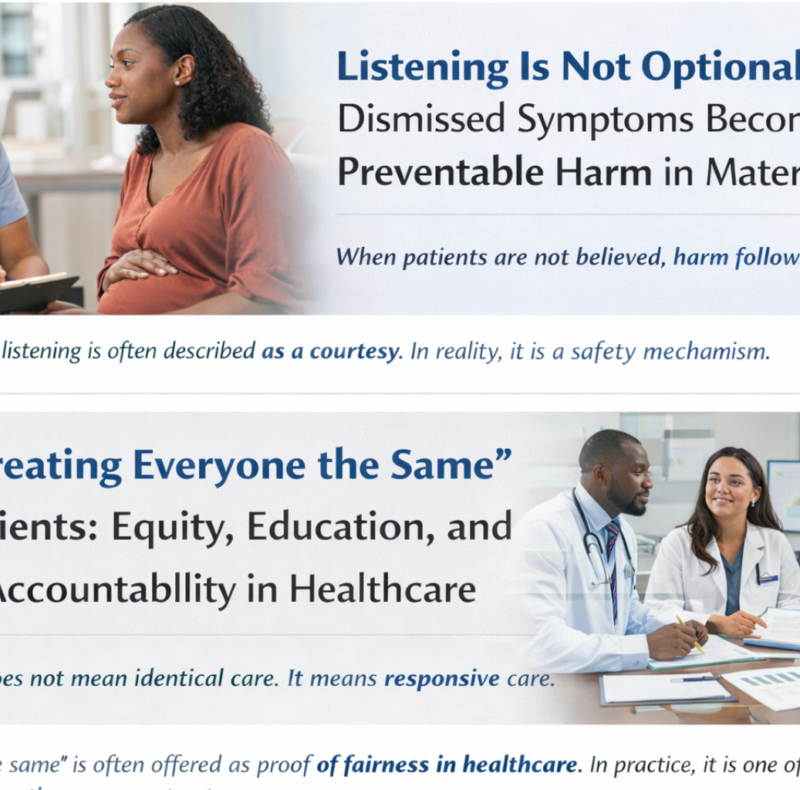
In nursing education and clinical settings, communication is often framed as a “soft skill.” In practice, it is a life-saving intervention.
I’ve reviewed cases where patient concerns were documented but minimized, where symptoms were labeled as anxiety or noncompliance, and where escalation was delayed because the patient did not present in a way that aligned with provider expectations. These patterns are not about individual malice. They are about systems that reward efficiency over curiosity and compliance over connection.
The Institute of Medicine (now the National Academy of Medicine) has long emphasized that communication failures are a leading cause of adverse events in healthcare. One report notes:
“Poor communication among healthcare professionals is one of the most frequent causes of medical errors and patient harm.”
What is less frequently acknowledged is how communication failures disproportionately affect patients who are already marginalized.
Bias Is Not the Same as Intent—and That Distinction Matters
One of the most common defensive responses I encounter in education and consulting is, “I treat everyone the same.” While often well-intentioned, this statement ignores how implicit bias operates.
The National Institutes of Health (NIH) explains that implicit biases are unconscious attitudes that influence decision-making, even among providers who consciously reject prejudice. Research consistently shows that pain assessment, symptom credibility, and urgency of response vary by patient race and ethnicity.
From my experience, the problem is not that clinicians don’t care. It’s that many have never been taught how bias shows up in real time—or how to interrupt it without shame or defensiveness.
Awareness without accountability changes nothing.
Education Models That Reinforce the Problem
Much of this begins long before clinicians enter independent practice. Nursing and medical education remain heavily test-centered, emphasizing task completion over relational competence. Students are taught what to assess, but not always how to engage. They learn protocols without practicing presence.
As an educator, I’ve seen how outdated models fail adult learners by separating clinical reasoning from communication, and empathy from evaluation. When education prioritizes correctness over connection, graduates enter practice technically prepared but relationally underdeveloped.
This has consequences.
Patients don’t experience care in checklists. They experience it through tone, body language, listening, and follow-through. When education neglects this reality, disparities persist—no matter how advanced our technology becomes.
What Ethical Care Requires Now
Ethical care in unequal systems requires intentional disruption. It requires clinicians and institutions to move beyond neutrality and into responsibility.
From my professional standpoint, this includes:
- Treating communication as a measurable clinical skill, not an optional add-on
- Embedding bias awareness into ongoing competency training, not one-time workshops
- Shifting from defensive postures to reflective practice
- Creating accountability structures that track disparities, not just averages
- Centering patient narratives alongside clinical data
The World Health Organization (WHO) emphasizes that respectful maternity care is a human right, stating:
“Disrespect and abuse during childbirth are violations of trust and dignity and can discourage women from seeking care.”
Respect is not abstract. It is practiced—or it is not.
From Neutral to Intentional
In my consulting work, I remind teams that intention must be visible. Patients can feel when they are being managed versus when they are being partnered with. They know when their voice is tolerated instead of valued.
We do not need more statements of concern. We need better habits, better language, and better accountability.
Change does not require perfection. It requires willingness.
When clinicians understand that communication is not separate from care—but central to it—we begin to see different outcomes. When educators teach presence alongside pathophysiology, students practice differently. And when institutions acknowledge that neutrality sustains harm, they can finally move toward equity with integrity.


No comments
Be the first to comment.