








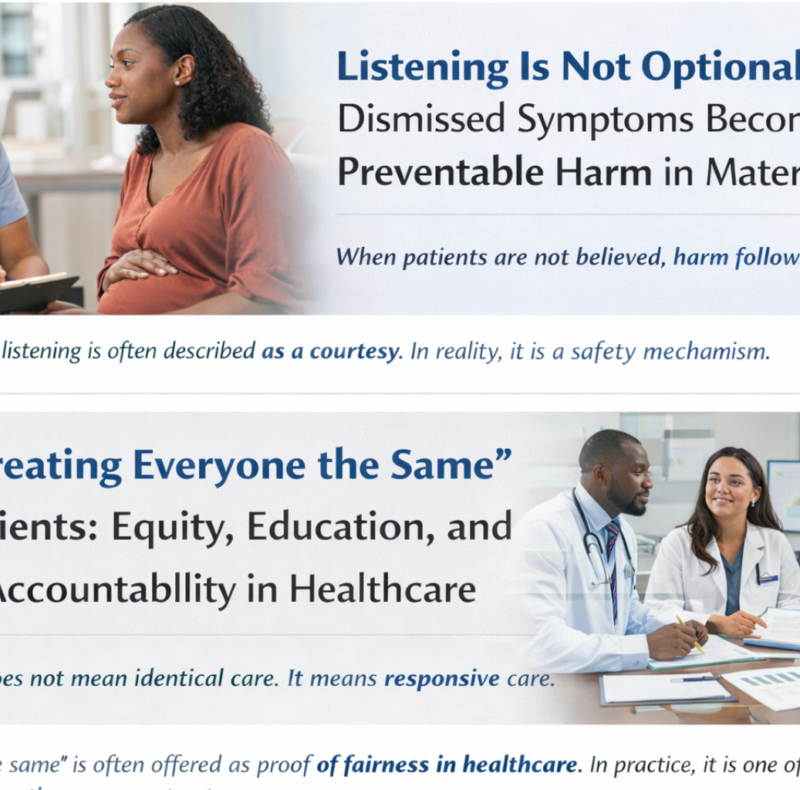
Why “Treating Everyone the Same” Fails Patients: Equity, Education, and Ethical Accountability in Healthcare
“Treat everyone the same” is often offered as proof of fairness in healthcare. In practice, it is one of the most harmful myths we perpetuate.
As a Family Nurse Practitioner, nurse educator, and healthcare practice consultant, I have seen how equal treatment in unequal systems produces unequal outcomes. This is not a moral failing of individual clinicians—it is a structural failure that persists when neutrality replaces responsibility.
Ethical care does not mean identical care. It means responsive care.
Equality Is Not the Same as Equity
Healthcare systems are built on protocols designed for efficiency, not equity. When those protocols ignore historical and structural disparities, they reinforce them.
The American Medical Association (AMA) defines health equity as:
“Optimal health for all, achieved by addressing systemic inequalities and injustices in healthcare.”
Yet many clinicians are never taught how equity translates into bedside decisions. Without guidance, “treating everyone the same” becomes a shield against discomfort rather than a path toward justice.
How Neutral Policies Produce Predictable Harm
From my audit work, I’ve observed policies that appear neutral on paper but disproportionately disadvantage certain populations—particularly in maternal health.
Examples include:
- Pain management algorithms that ignore documented racial bias
- Rigid visitation or support-person policies
- Escalation criteria that undervalue patient-reported symptoms
- Disciplinary responses to advocacy labeled as “noncompliance”
The CDC has acknowledged that social and structural factors—not individual behavior—drive many maternal health disparities. The agency states:
“Structural racism and implicit bias within healthcare systems contribute to differences in access, treatment, and outcomes.”
When systems fail to adapt, neutrality becomes complicity.
Education That Avoids Discomfort Avoids Change
Many healthcare education programs address disparities superficially—often as a single lecture rather than an integrated competency.
As an educator, I have seen learners graduate without ever examining how power, perception, and bias shape care. They are taught to avoid discrimination, but not to confront inequity.
Avoidance does not protect patients.
The National Academy of Medicine emphasizes that health professionals must be trained to recognize systemic drivers of inequity, noting:
“Improving health equity requires transforming education, training, and practice environments.”
Without this transformation, clinicians enter practice underprepared to challenge harmful norms.
Accountability Without Blame
Equity work often stalls because it is framed as accusation rather than responsibility. From my perspective, accountability is not about shame—it is about ownership.
Healthcare professionals can care deeply and still participate in inequitable systems. Naming that reality allows growth. Denying it guarantees stagnation.
Effective accountability includes:
- Transparent review of outcome disparities
- Continuous education tied to real clinical scenarios
- Leadership willing to address patterns, not exceptions
- Language that invites reflection instead of defensiveness
What Ethical Care Demands Now
Ethical care requires intentionality. It requires clinicians to ask not only, “Did I follow protocol?” but “Did this protocol serve this patient?”
Equity does not weaken clinical standards. It strengthens them by aligning care with reality.
From my professional standpoint, progress begins when we stop hiding behind sameness and start practicing responsiveness.
Patients do not need perfection. They need presence, humility, and systems willing to evolve.
Neutral care feels safe to providers. Intentional care saves lives.


No comments
Be the first to comment.